It can now be viewed by going directly to this link:
Wednesday, July 25, 2007


Monday, July 23, 2007
Minutes of the Bangalore Technical Writers Meetup for July '07

The Bangalore Technical Writers meet up-supported by STC India for this month was held at Proteans Software Solutions Pvt. Ltd, on Saturday 21st July 21, 2007. The topic for the discussion was “Theories of English Grammar for Technical Writers”. Anil Pinto, Lecturer in Communication and Media Theory, Christ College, Bangalore discussed with us on this topic.
Anyway, the name of the attendees' and their respective companies are listed below:
1. Anil Pinto – Christ College
2. K Sassendran- Proteans
3. Radhika Nair -Novell
4. Anindita Basu- Integra Micro Systems
5. Cresilla Lobo- Robert Bosch
6. Blessy Thomas- Citec
7. Vandana Rao- Alcatel-Lucent
8. Sinduja R- Honeywell
9. Manjunath- Truimph India
10.Saiprabha- SAP Labs
11.Nethravathi - C4C
12.Aaron R- Wipro
13.Binu PV-Lauteb Information
14.Jaimon Mathew- IGS
15.Sreejesh-EDS
16.Rajeeva B.C- NA
17.Sreejith G.S- Collabis India
18.Vinay Kumar- Consultant
19.Sunita S- Wipro
20.Chaitrao M- G4S Training Centre
21.Reena Lasrado- G4S Training Centre
22.Suchitra- Proteans
23.Rashmi Hebbur- Journalist
24.Banurekha Balaji- Honeywell
25.Jothi- NA
26.R.S.Raju- Adroit
27.Jayant Gandhi-
28.Rajdeep Gupta- Infosys
Highlights:
The meeting started at 11.15, by a quick round of informal introduction. The most interesting point about this session was that the attendees were from various working background that cut across different domains- from Film Making to Economics.
Rajdeep triggered the meeting by welcoming the attendees and the speaker Anil Pinto. Anil kicked of the interactive session by handing over the worksheet to the attendees. The participants were asked to fill in the quiz on “what is Grammar” and “What are the theories of grammar” followed by a discussion on the different answers that the participants came up with.
Anil could easily set off a great interest among the participants to listen to and actively debate on. He discussed the following Grammar theories: Traditional, Structural Transformational-generic.
Traditional theories can be tracked back to 18th century, wherein Orthography, Etymology, Syntax, Prosody, Composition, Spelling, Pronunciation, Sentence Analysis etc were the major focus of study. The Renaissance movement- a cultural rebirth from the 14th through the middle of the 17th centuries in Europe forced the English to think beyond Latin for the style and structure of their language.
The major issue with the Traditional theory was that no two languages have the same grammar. Every language has its own inherent difference. Wren & Martin’s Grammar is one of the best examples that follows traditional grammar theories that focused mainly on words, rather than sentence or language as a whole.
Wren & Martin’s grammar book follows Shakespeare style of English, which is not applicable in many domains such as Technical Writing (though this domain was not evolved in those days; Anil just gave an example).

In response to these issues, a Structuralist theory has been evolved. When Traditional theory concentrated on words, Structuralist theory mainly looked at language as a group of different sentences. People like Saussure researched on 'Signs'. He considered language as signs. Leonard Bloomfield’s language (1933) is a book that refers to structuralist theories. Structuralist theory attempted to understand the grammar of the sentence rather than
grammar of words and its alignment in the sentence.
Noam Chomsky is one of the apostles of the Transformational-generic theory which advocated the importance of language. Anil walked the attendees though the difference between the Surface structure and Deep structure of language, and he also gave a glimpse on present universal grammar.
After the presentation, it was the exercise session that triggered debate among the participant on subject-verb disagreement. The discussion took to different levels, where Anil and the participants discussed about the bridge between academia and the Industry. One of the attendees has the opinion that the industry really does not favour the intake of trainees due to the confidentiality of the project. Everybody agreed upon the need of a curriculum for Technical Writing. Again, Regularity, syllabus and dedicated faculty are the major roadblocks to the aforementioned.
Rajdeep sought feedback from the participants about the venue for conducting future meetups. He also encouraged the Participants to volunteer their time and efforts in sustaining the activities of this group by giving presentations or seminars. Rajdeep also briefed about the upcoming STC-India Career Day and Annual Conference.
You can download the presentation from the following URL : http://techwriter.meetup.com/2/files/
Also, view the meetup photos from the following URL:
http://techwriter.meetup.com/2/photos/?photoAlbumId=190364&photoId=1767636&op=defaultAlbum
The particpants felt that Anil has kindled enough interest in them to delve deeper into the subject. We look forward to another session from Anil where we can learn about how words relate to, and play with each other.
Tuesday, June 26, 2007
Minutes of the Bangalore Technical Writers Meetup ((June '07)- Supported by STC India
The Bangalore Technical Writers Meetup for June '07-Supported by STC India took place in Adobe Systems on June 23rd, 2007. Listed are the attendees along with their respective companies' names:
1. Preran- ADOBE
2. Darshin Naidu- HSB Technologies
3. Anindita Basu- Integra Microsystems
4. Arun Martin- Bally Technologies
5. Bibhudatta Mohapatra- Intergra
6. D.Hemadri- Sun Microsystems
7. Joy M J- TCS
8. S.Gopal- Consultant
9. Benazir Hussain- Metalearn Services
10.Rishi Rajpal-Metalearn Services
11.G Raghu-Metalearn Services
12.Shabith Prabhakar-Metalearn Services
13.Ajit Kumar-Metalearn Services
14.K Anantha Raman-Metalearn Services
15.Rajlakshmi Borthakur-Infosys
16.Aunindra Sinha- Infosys
17.Vidya Lakshmi-
18.Shwetha Shashidharan- SAP Labs
19.Dhanish P Bhaskar- Fomax
20.Ramesh-GE
21.Pradeep L.N- Metalearn Services
22.Prabhat Ramesh- Four-C
23.Gururaj BS-ADOBE
24.Surag R- Honewell
25.Jilna Surag- Freelancher
26.Shashi Prabha- TCS
27.Banurekha Balaji- Honeywell
28.Blessy Thomas- Citec
29.Vikash Kumar- Cognizant
30.Saseendran K- Proteans
31.Manoj Potdar-Proteans
32.L.Chelladurai- ABB Global Services Ltd
33.Sreeram MV-ADOBE
34.Rajdeep Gupta-Infosys
The meetup started at 10.35 am and the agenda was "Developing interactive content". After a quick round of introduction by everyone, Rajdeep requested the speaker Preran to initate the discussion.
• Preran who has 7 years experience in Technical Communication and Web Design, started off with an introduction explaining-Learning, Various types of Learners, Interactive Learning for Simulation etc.
• After that Preran discussed Adobe Captivate's TM features like adding interactive tools e.g. text box, mouseclock. He showed how to record presentations (for example, a demo), and explained the multiple output formats for publishing.
• Preran also showed us how to create a quiz question, and the various quiz types that can be created using quiz templates for assessing user at the end of any training presentation.
• After that, Sreeram M V, Product Manager for Adobe Captivate interacted with participants on the Captivate usage. He responded to the user's queries related to Captivate, which they face during projects. The discussion was lively with users providing feedback on the Captivate tool. The participants also tried to clarify questions posed by each other.
The session concluded at around 1 pm with some informal one-one interactions.
Click here to view the photos http://techwriter.meetup.com/2/photos/?photoAlbumId=177937&photoId=1602283
Also, the meetup presentation is available for downloading at http://techwriter.meetup.com/2/files/
Saturday, June 16, 2007
Interwoven Session on June 16, 2007
I had the privilege to attend the STC Learning Session on Usability conducted at Interwoven (June 16, 2007), and am sharing the session’ gist with you.
The first speaker was Sherrill Packebush, a User Experience Analyst with Interwoven who delivered a presentation on HCI and Tech Communication. She gave a basic idea of what HCI is, responsibilities and the role of tech communicators in designing.
Sherill said HCI does a lot of research on the designing and development activities. She also shared her experiences in creating wireframes, prototypes and all. In addition, She highlighted some case studies on usability namely on Amazon. com, move.com and staples.com.
She pointed out that one of the distinguished companies had to shell out $ 900, 000 on Usability issues for they ended up doing the test on the engineering team and never thought of performing it on end-users. Finally, she discussed some usability problems that are been encountered frequently.
Next was Suman Kumar, writer with DELL who delivered a session on Contingency Design, its importance and writers role in it. Citing examples, Suman said that Error messages should be treated as educating the customers. He also cited some practical examples wherein vague error messages have proved costly to the flagships of the product.
In addition, Suman thought that the following points in mind while writing error messages. Error Messages need to be identifiable, accurate, understandable, succinct, correct measure and explain what went wrong. According to Suman, writers are the perfect customer advocates and should play key roles in getting the customer requirements picture clearer to the design and development team. In a nutshell, always try to be on the user's shoes when writing error messages.
The session concluded with a Q & A.
Friday, June 01, 2007
Points on Documentation Survey
Hi Francis,
At the outset, an excellent chance to do something new out here!
Though I ain't in a position to disclose the Questionnaire (client policies and all), I will share my experiences. I had a chance of revamping the entire documentation for a particular XYZ client.
The first thing is that while I understand you are potboling with enthusiasm to be creative and come out with a new structure, please do not be in a hurry. If time permits, do an analysis of the existing manual; list out all the documentation issues in an excel sheet and try to figure out the possible alternatives to it.
Now, when you are done with that, try to chalk out in a piece of paper as what is MISSING in the document? If possible, have a coffee talk to your fellow mates, clients and end-users (if possible). If not, never mind. I suggest you to look into the customer support emails.
I am sure, there are documentation issues, which might be relevant in terms of language, structure etc of the document. Take this factors into consideration before you start with your new draft.
Create a list comprising of three sections- Major, Minor and Critical and correspondingly departments under which it should go. If there are technical documentation inaccuracy, which is major, the issue should be sorted out by the documentation team, in that case it is you.
If there are incorrect steps documented, which may lead to a wrong action on the part of the user-say an installation step, the issue is critical. If there is some mismatch with the GUI buttons failing to work and all, you need to get in touch with the development or design group. At the end, try to look out possible alternatives and come out with a solution and resolve the matter.
Try to also conduct out a test in the team itself of how users read the documentation. You will get a good idea of the readability of the documentation.
I don't know, but you can perhaps look to explain the features in a new manner-- how about creating a demo, identifying the unique features of the product.Also add a few quzzies in the note and provide feedback in the form of correct or incorrect messages. Always try to get the users in action.
My two cents
Regards Rajdeep
---------[ Received Mail Content ]----------
Subject : [twin] Documentation surveys
Date : Tue, 22 May 2007 19:06:30 +0530
From : "Francis Anthony"
Hi:
I'm starting out on a new documentation project whose content needs to be completely overhauled. I figured that the best way to go about overhauling existing documentation would be to understand:
* What is it that users found lacking in the status quo, and
* What is it that users would like to see in the revamped
documentation
To this end, I will be conducting a scientific survey of the documentation. Has any one undertaken a similar effort previously? If so, I'm interested in hearing from them about their experiences. Broad tips on how they went about it, how much time was spent in the effort,
what kind of questions formed part of the questionnaire, etc. would be greatly helpful.
Please feel free to write to me and to the group, if you like, to share your experiences and insights.
Any and all information would be much appreciated.
Many thanks,
Francis
Tuesday, May 08, 2007
Staright from the Organizer's Desk!
I came, I saw, and I conquered - I would like to use the axiom of Julius Caesar, to describe the Bangalore Tech Writers Meetup Group Let me take a breath here! Phew, wasn't I nervous, when Saravanan Manoharan (aka Sara) made me the Assistant Organizer of the Bangalore Meetup .
I still recall that day, when Sara called me over and said, "You are taking it over from here." Initially, I was amused as to why he chose me out of the whole bunch of seasoned technical writers in Bangalore?
But, then Sara patted me on the back, and felt that I could deliver. Well, I don't know, if I have lived up to his expectations (and those of Bangalore Tech Writers), but I can only say that, "I am trying my level best."
To be completely honest with you, it hasn't really been a smooth sailing. I have been blasted quite often, off the list by quite a few members; they were of the opinion that the agendas were offbeat and the venues were improper. I would like to use this platform to respond to some of those remarks. Please note, that in no way am I trying to incite a flame here. I am doing this with a good intention.
As far as I could make out, offbeat topics would be categorized as those topics which do not have any direct co-relation with technical writing. Here, I'd like to point that the Agenda for the meetup include topics that are selected by a panel of technical writers, including yours truly.
Over the last year, we had meetup agendas ranging from a wide range of topics such as, "Reviewing and standards", "Ways/ Methods of continuous learning for Technical Writers", "Procedure/ Steps i nvolved in planning and preparing a Users Manual for a product" to the recently concluded "How to catch errors once you freeze docs?" etc.
How many of you think these are offbeat topics? Does it not help you with your (technical) writing? I guess, what my fellow mates meant was that we should conduct technical writing sessions, in which they will have tools-related questions and all. Nothing wrong in that!
We also have had agendas on topics related to Tools (In the past, we had an agenda titled, "MS Word vs Framemaker"), but in a different atmosphere for sure - we don't encourage the use of boards, fancy conference rooms, or even a pen/ pencil. We chose to be a little different, guess there's no harm in that, right?
My point, here, is that we are not using this Meetup group to conduct learning sessions; we are just discussing an agenda informally and learning simultaneously. Our soul objective (and mind you, its 100% voluntary) is to work out solutions that one faces in day-to-day life and encourage everyone to do their bit for enhancing Technical Communication.
Few people who have turned up for such meetups have been pretty supportive in giving their feedback, and this in turn has done us a world of good. A few drops of water can make a mighty ocean. There's another issue facing us, as an entity - choosing the right venue of course. Writers who have attended the meetup complained about the venue - noisy and loud music.
While I understand and take the comments with a bowed head, I would also like to say something here. We usually have such meetups at a Coffee house or a Restaurant; to conduct a meetup in one of these places requires financial assistance. As of now, the meetup is a voluntary group. Hence, I cannot organize it in a Hotel or in a Conference Hall. I am talking to various people and orgs to organize such meetups at their premises (office rooms) for an hour or so, but its not easy to convince them.
Also, it defeats the purpose to have an informal meetup - the basis on which the meetup idea was born. We would like to keep as it as informal as possible. My request to fellow writers is -> Please have some patience and I am sure, we will work out something. But, it's not been harsh always. We have been able to do a few things quite uniquely, if I can say so.
To start with, we had some recruitment/ HR personnel joining us regularly. It gives me immense pleasure to inform all of you that some participants from the meetup have secured jobs as well by networking. In addition, there have been certain representatives from technical writing institutes, who have got students enrolled. Good news, isn't it?
As we approach another year, I would like to seek an active hand from all of you. To start with, I would like to know what sort of discussions can we have in such meetups, time and venue you would like to suggest? Do you like to have meetups where we make effective use of a whiteboard? Please feel free to voice your opinion offlist to me. My email address is < > My gratitude to Saravanan Manoharan for his constant support and feedback.
Just like another Technical Writer, I am also trying to learn the intricacies of technical writing and group meetings like the Bangalore Meetup has surely given me the confidence and knowledge to go a long way. It may be true for some more writers like me.
I am sure the coming year brings a lot of happiness in each and everyone's life. I urge my fellow writers in Bangalore to extend a hand to my meetup efforts, so that we can help ourselves to be worthy Documentors.
I know TIME is a real factor here, and weekends is the only time when everyone wants to windup, but trust me if you can contribute a little time of yours in such meetups, it definitely adds value to you writing. Finally, I look forward to receiving mails from all quarters about the Meetup. Thanks for your cooperation! Let's make the Bangalore Meetup the best of its kind. Cheers! Rajdeep
Wednesday, May 02, 2007
API Session with Rajeev Jain

Technical Writers April Meetup
Agenda: Documenting your first API.
Attendes: 17
The attendees' names along with their respective companies name are listed below:
1. Rajeev Jain - Zilog
2. Lakshmi RS - Gemini Software Solutions
3. Reuben - Arcot
4. Shashi Prabha - TCS
5. Sumit Kumar - Lucent
6. Naveen Chandra - Cokinetic
7. Harish BS - Keeline India Ltd
8. Abhilash Scariya - SAP Labs
9. Imran Ulla - First Indian Corp
10.S Gopal - Goodwill Technologies
11.Priyadarshini Narendran- Zilog
12.Mamata - Arcot
13.Jainthi Sasikumar - Argos Soft
14.Shoba Shanker - Citec
15.Anitha Sadashiv - Technopoint
16.Vishalakshi - Technopoint
17.Rajdeep Gupta – Infosys
Highlights: The session began at 10.30 am. After a formal round of introduction of participants by Rajdeep, Mr. Rajeev Jain started the presentation. It was quite an enthusiastic and interactive session.
Mr. Rajeev Jain started the session by explaining the basics of programming (sequence, selection and iteration). He said that if one understood the programming basics, documenting API was not difficult. Later he spoke on basics of API writing and how different was API documentation from GUI documentation. The do’s and dont’s while documenting APIs were also discussed.
The entire discussion was made easy to follow by providing apt examples of C++ APIs.
Clearing the doubt of one of the participants, Mr. Rajeev said that APIs could be classified into two-Internal APIs and External APIs. Usually, it is the external/exposed/customer facing APIs that are documented.
Answering another question as to what all should be included in the API documentation, Mr Rajeev said that the API document was like a dictionary to the programmer, which was never read from cover to cover, but referenced on an ad hoc basis. He also provided with a sample API document template, and explained the various headings and the reason for the particular heading order.
The meeting concluded with idea that API documentation was very easy, provided one knew the basics of programming and that, API documentation is also a lucrative career option.
The writers attending the meetup found it very informative and useful. Those who were in API documentation got a better idea of what to do, and the rest got an idea of what API documentation was all about.
A few attendees expressed their desire to be regular in meetup.
Mr. Rajdeep concluded the session by offering a vote of thanks to Mr. Rajeev Jain for delivering a wonderful presentation and to Technopoint for sponsoring the meetup.
You can view the meetup photos by clicking the following URL
http://techwriter.meetup.com/2/photos/?photoAlbumId=156076&photoId=1336004
The presentation will also be available at the Meetup website ; you can get in touch with Rajdeep for further details.
Tuesday, April 17, 2007
Seminar on Adobe's Products
{I wrote this in July 2006 and following requests from various quarters, thought of sharing it with folks interested to know as what happened in the Adobe Seminar.}
What was the Seminar about?
The STC India hoisted a unique event for Bangalore –based technical writers on last Saturday (July 15th, 2006). It was a meeting that was a discussion platform on how companies/users use the Adobe products for their specific needs and issues. The meeting venue was at Adobe, Bangalore and was attended by technical writers and Adobe’s product managers. It was also perhaps a befitting occasion for many of the companies/users to show their gratitude and express their requirements to Adobe. Yours truly was present in the seminar and thought of sharing the meeting minutes.
Who all participated?
The meeting started at dotted 10am IST. Gururaj BS, immediate past President of STC India kicked the meeting by welcoming all the participants and invited the Adobe Product Managers to talk over the agenda. After the initial roundup it was the time for Presentations. There were six presentations delivered on that day, and each of them lasting more than 25 minutes. Anyway, I am listing the companies in order of their sequences:
PIVOTAL SYSTEMS
SLING MEDIA
HONEYWELL TECHNOLOGIES
ICALIBER
INFOSYS TECHNOLOGIES
What did the writers spoke on?
PIVOTAL Systems were the first to kick start the presentation. Pravin and Vatsala of Pivotal delivered the presentation. Their presentation highlighted: how PIVOTAL uses RoboHelp and Framemaker in their Technical Documentation and the features that they believed would make it better.
PIVOTAL SYSTEMS highlighted on the following points:
Conditional text of RoboHelp
A format painter like Microsoft Word needs to be available in Framemaker
Reviewing Format should have more outputs. Everyone present felt Framemaker needs to have a good Review format for everytime it is not possible to send a PDF document for review.
SLING MEDIA
Next was the turn of Mayur Pollepalli of SLING Media. Mayur with his penchant knowledge in RoboHelp highlighted the following:
A better and refined UK Dictionary should be available for RoboHelp as well as FrameMaker
Spell check in Books as well as topics across should be allowed in Framemaker
Mis-spelled words should be highlighted in RoboHelp
Grammar check should be allowed in Framemaker.
The participants kept on highlighting the features that would have wanted RoboHelp to have, and the Adobe Product mangers were no short of responding to their queries and also cross-questioning them.
A break of 20mins was taken after Mayur’s presentation, and it was spend in relishing pastries and samosas that did take care of the attendees’ stomach.
After the initial two presentations, which concentrated on RoboHelp and Framemaker, Surag Ramachandran of Honeywell Technologies took the centrestage with his presentation titled ‘CAPTIVATE AND ME’.
Honeywell Technologies
Surag highlighted the following points:
¨ Captivate has a tendency of crashing down more than often once the demo becomes large.
¨ Captivate lacks professional caption tags.
¨ Captivate disallows users from editing PowerPoint presentation after it is imported.
¨ Captivate’s option of importing presentation is not user-friendly. Based on the two options that captivate allows, you can either have the presentation before or after the video. Hence, you are in a for a tedious task of drill and drag if you are have to your slides between the videos.
Following Surag’s agenda was Pradeep Vasudedvan of ICALIBER who went a next level and spoke about the cons of Audio in Captivate.
ICALIBER
Some of the points that Pradeep highlighted were:
¨ Once a slide is deleted, the audio in the presentation becomes blurred
¨ The audios make the presentation very slow
INFOSYS
Rajdeep was the next one to grab the microphone and this time donning the coat for Infosys Technologies. Rajdeep’s theme for the presentation was ‘Pros and Cons of Importing docs in RoboHelp’ and surprisingly, it did catch the audience 's attention. One of the two reasons that he chose the theme were ‘the hassle that a fresher in technical writing undergoes when he or she is asked to generate an Online Help system using FrameMaker or RoboHelp as an authoring tool’.
Sometimes they end up doing sub-optimal work because learning the nitty gritties of a tool and acquiring skills in Technical Writing takes time. So in this scenario, Microsoft Word does a fantastic job. A Trainee Technical Writer is pretty conversant with MS Word and it is one of the easiest authoring tools. Anyway, the following points were raised:
¨ Formatting becomes a real issue after the Word document is imported in RoboHelp. Studies reveals almost 70 per cent of Technical Writers spend more than half of their working hours in formatting. In that case, the work done on content development is pretty less.
¨ There is no feature available to define the hierarchy of imported information
¨ Some RoboHelp versions like X4 and X5 show incompatibility across MS Word versions.
¨ There is extra manual intervention if you are converting PDF files . A 2-step procedure is required – step 1: conversion to text form using an OCR and step 2: importing the HTML/Word file into RoboHelp
¨ More often than not , hyperlinks and cross references are lost
¨ Easy automation is not facilitated – for example, batch conversions of images or batch converting images imported into thumbnail images.
¨ Reducing the image size every time. Every time you want to insert an image in RoboHelp, you need to use the Image editing tool like Adobe Photoshop. Can RobHelp provide an in built format painter?
Lunch
The meeting closed by 1:30 after which we had a very sumptuous lunch.
Final Comments
I did manage to get a tete-a-tete with the Adobe Product Managers, and they assured us of the following points:
¨ Robohelp’s future roadmap is secure. All the reports leading to their closure are misleading and false
RoboHelp is soon going to come out a feature that allows importing XML files
¨ Adobe’s latest project revolves around the ‘importing docs’ in RoboHelp. So, we might just see advancement in the days to come by.
¨ Macromedia Captivate’s Beta Version will be launched soon.
¨ Adobe is also planning to start off their Documentation team in Bangalore soon.
It was a very enjoyable and enthralling session that lasted more than 2 hours 30 minutes. I had a great time and so did the rest.
Hope we have more sessions in the days ahead!
Monday, April 09, 2007
Talk on Web Search and Online Communities
5th April, 2007, as part of Big Thinkers India series, Yahoo presented a discussion on 'Web Seminar and Online Communities' at Taj Westend, Bangalore. Distinguished researcher of Yahoo Search, Andrew Tomkins spoke on the same and enthralled the audience with insights on Yahoo's works on Search domain, Implementation strategy using algorithms and latest technologies related to Search.
Andrew based his presentation with various available online communities and their contribution to Search. But before Andrew started with the presentation, there was an introduction by the Yahoo Research and Development team to the audience. The gathering, which included usability specialists, software engineers, designers and technical writers from various companies namely- Yahoo, SAP Labs, Infosys, Accenture etc and a host of students and professors from prestigious engineering colleges - IIT Khargapur, Kanpur, IIIT Bangalore and DCSE were waiting patiently for Andrew to start.
Andrew started his session at 1530 hours and gave a walk through of the topics that he would be touching that evening. Andrew spoke on content formation, fragmentation, online communities' importance and strategies for the future. He started with the website FLICKR and identified it to be a potential social network. It is because Andrew thinks FLICKR is not only a rich and diversified photo sharing website but it contributes a major chunk of internet traffic.
During a research conducted by Andrew, he noticed that people are more prone to engage in photos that are clear and conveys a message. As part of this, FLICKR has a strategy to involve group members in a discussion list and also add their favorite photographers in a list of the same.
Next, Andrew touched on web content and spoke on its relevance in today's technological world. He stressed on the importance of creating content by understanding the user's perspective, and warned otherwise of falling short of web's potential.
Though Andrew didn't wish to divulge on the Yahoo's Search initiatives, he provided some cues. First, the Yahoo search engine teams are working to improvise on their current structure and plan to give other search portals a run for their money. Also, they are working to have a content mixed image search; it means when you do a Yahoo search for Rockstar,Jim Morrison, the search results will be displayed along with his hyperlinked image on the left. In addition, you can view Jim's Bibliography, Songs, Concerts timings etc. On clicking the link, you have the dual option to go to the resource and also revert to the website.
There are also talks going on to have a drop drag search option. If successfully launched, it would give a refined look to the Search concept wherein you can drag any image to the Search page, and the desired results page will open up.
Andrew then spoke on social networks like Orkut, hi5, Gazzag and provided certain blogging tips. He also made some interesting observation regarding the search filters carried by people of all ages. The research shows that kids between the ages of 3-6 years are more likely to search for bicycles, pencils and pens while people in the ages of 50-60 are more likely to do more searches on Poetry, God, Religion etc. In addition, Andrew touched upon a bit of his work related to studying bullentin boards posting.
The house was open for an Q&A session next; Andrew was happy to respond to queries from audiences on various issues. The session got over and participants were treated to a high tea. I had a great evening, enjoyed the talk show, interacted with the participants and learnt that before we get started it is essential to understand what it takes to get to the top of the search engines.
Friday, April 06, 2007
Launchpad for a Writer
[When I was planning to start my career as a technical writer, like most of the wannabees, I too had lot of questions. At that point of time, I had to fall on Google or refer some list servs for the materials. So, I had decided that when I become a writer, I would jot down my experiences of how to go on with the hunt for a technical writing job. Success came and along with admiration brought a great deal of responsibilities. This article of mine is a part of my responsibility to the Technical Writing fraternity, but please note that it doesn't include everything that you should do to begin as a writer. Rather, I advise you to treat it as a reference material. Added to it, I would appreciate if some of the writers could share me pointers for this article. It would help me to enhance and beautify this article. I'd not like to give gyaan to writing gurus but always have this penchant for sharing knowledge, for knowledge increases when you learn to share. Trust me, it will give you immense joy. Enjoy the article and please comment]
“ A single step and a giant leap for mankind.”
The above quote has been aptly true for mankind’s adventure. It holds true for Technical Writing tryst too. Congrats on taking your first step! Well done!
Technical Writing is a very rewarding and at the same times a very competitive career. You must be an enthusiast and a keen team player to rise to the top-level, always be proactive, open to take any challenges and a go-getter in every word. I presume lots of questions are pondering across your mind. How do I take the first initiative? Where do I apply for jobs? To whom should I get in touch? Do I need a technical writing certification? How are the coaching centers? Relax! In this article of mine, I’ll try to cover on some areas of technical writing. Please note that these are based on my personal experiences and in no ways reflect technical writers overall.
Developing an interest in technology
This is the primary skill for qualifying oneself as a technical writer. He or she has to have a knack for technology. Once you develop that inquisitiveness, everything will fall proper in its place. It is essential for today's technical writers to identify themselves in the arenas of technology. It is not essential because they will be writing on technological subjects, but an interest in technology helps to understand it better. As an effect, a technical writer will be able to provide quality documentation, and at the same time their inputs would come handy. At a later front, this interest helps writers to get a thumbs-up in the developers' coffee zone.You'll also earn more respect from your colleagues, which is always an area of concern for every technical writer.
Earning a Technical Writing Certification
Once you have developed an interest in technology and ready to write, ask yourself: am I ready to get a job without certification? It is a debatable subject and various writers have got mixed responses on it. It is where your knowledge and foresight comes into picture. By default, you will turn to some senior writers or fall into someone who has undertaken technical writing course. However, if I were to paint a picture of technical writing scenario today, I’d select a candidate with a certification in Technical Writing. Why? Obviously, the time and money spent on training a fresher in technical writing could be utilized in some other fronts.
The fact is that Technical Writing scenario has drastically changed over the years. Five years back anyone with an aptitude for technology and writing found a room in a technical writing. Things have changed over the years, and companies have started laying more importance on a TW certification. It has come to a position wherein a person whose resume covers specilisation in the arenas of tools and domain knowledge gets the first nod.
Enrolling yourself in a good Technical Writing Institute
Hunting for a Job
Now that you have successfully undergone a technical writing course, it is pertinent that you start applying for jobs without wasting much time. If you are lucky enough to get a placement from the center itself, well and good, otherwise some serious job-searching needs to be done. Before you start applying, do understand that failures are the stepping stones to success, and so even if your initial attempts fail to reap dividends, don’t panic, for it’s the last thing that would matter. But do pick up the points as where you have faltered every time, and try not to commit similar mistakes the next time.
As a fresher, I used to maintain a log book wherein I recorded each and every input that I received for my interviewer. At night before I went to sleep, I used to read it aloud every time. It did help me to reduce the errors.
Applying Procedures
As a fresher, I presume technical writers do not give much thought when applying for an interview. All they are concerned is to send across the resume, but most of the times without any proper homework, as a result of which they run helter skelter afterwards. It’s always nice to be to take a little bit of notice before you start applying for jobs. As a newbie, follow the steps listed below:
Preparing an effective resume
A resume or curriculum vitae outlines your career profile in a short. Hence, it should smell of honesty and accurate information. No information is good if it misleads the interviewer. Try to be objective and never stray away from your points. An important point is does a technical writer’s resume differ from others. The core area of your job profile is on ‘writing’ and hence emphasize on your writing skills. List out all the major achievements that records your writing capabilities. Always do a F7 and see that your resume is devoid of any spelling or grammatical errors. Make a conscious attempt to be honest and show that you are enthusiast. Almost half a dozen of resumes are left unnoticed because of the unstructured way these are written.
Listing out the Achievements and Skills
I reviewed a resume the other day wherein the lady had mentioned skills in cookery, painting etc. All this are excellent, but when the question is that something paying dividends to your writing skills. I do not encourage people to list out achievements except their writing skills. Sorry! but that's the truth.
Searching for a Job
Almost everyday in technical writing mailing lists, umpteenth number of job postings are made. Though most of them are meant for experienced professionals, some companies seek freshers too. Hence, it’s essential to keep your eyes and ears open. Subscribe to mailing lists aka twin-india.org, and do regularly keep a tap on the job advertisements of the newspapers.
Sending out an effective email
Your interview phase actually begins when you applied first for an interview. Please do not be blind that the HR representative doesn’t take care of your email. A good HR will always sketch out and show it to the others to have an effective viewpoint. Needless to say, as a technical communicator you are required to be immaculate in your writing and speaking skills. It makes your task of getting jobs very easy. Take the few points listed below:
Be Patient
A company which has excellent track record in both their products and services will never hire people with a poor or shabby record. After they receive their resumes, they have every right to scan it before they call you up for an interview. Be calm- they are not only testing your technical skills but an overall assessment of how you grope in a situation. If you don't hear from them within a week, don't CALL. Wait for sometime and than maybe you can email them. I expect companies to respond email immediately if they are interested; else, you can deemed it as NO.
Give a valid subject tag
Setting up an objective in your email.
Be direct in establishing the tone of the content between the subject and writer.
Being Proactive
Proactive is the buzzword in the corporate hub. From the day you sit in the job chair to your last day in office, be proactive at your work. The designation of a technical writer is that of a qualified individual who not only writes well, but someone with excellent communication abilities. Please be ready to work on any array of writing- user guides, proposals, collaterals etc. The technical writer has to be clear-headed and as approachable in his job affairs. Also, refrain from any party politics.
Being Passionate
You need to be passionate of each and everything that you work upon. It can be start right from the team meeting eve and stretch to SME interactions, gathering inputs and all. What is important is that the documentation should have a definite plan and should be technically accurate and precise.
Developing an inclined steep curve
Learning is maximized in the sense, when you have more creativity at stake in one hand and technology at other end.
Preparing yourself for an interview
Most of the companies have rigorous interview sessions with you before they select technical writers. Though it is unethical to divulge interview questions, I can assure you that some of the basic queries regarding technical writing would be addressed and don’t ever press the panic button if you aren’t sure of a query. Just be honest enough to admit that you do not have the proper answer(s) to the question.
Searching written materials
Understandably, as a fresher, you won’t have ready made experiences in corporate world, but the job posting ads these days asks a technical writer for some writing experiences. Instead of running helter skelter, I recommend you to take a look at some open-source projects and create documentation on it. Once done, get it reviewed by a seasoned technical writer.
Earning Tricks and Tools
Learning tools online is an easy step. Umpteenth numbers of websites are available on the net. Use certain websites to learn FrameMaker and Snag IT.
These are some of the tools and tricks for you to follow. I am sure there are more recommended by technical writers. Treat this as a reference. But always believe in yourself and have an aptitude to learn always. Success will definately come- it might take a bit time, but will for sure.
Monday, March 26, 2007
Usability Session in ST. Marks Hotel
No sooner had I got down from the Richmond flyover, my mobile started to beep. It was Nancy calling me from Hyderabad, and she was excited that I was going to be a part of CHI Bangalore event. "Dude, please collect all the information and share it with us".It wasn’t Nancy alone; I had received requests from my closest buddies- Sowmya, Greshma,Alex, Naveen, and all that they wished to know was what the event was all about. I could never say NO to this folks. Though it was my sleeping time,but thanks friends for getting me engaged me in an activity. Surely, you guys owe me a lot.
22nd March of 2007, and I reached at dotted 3pm in St.Marks Hotel,Bangalore collected my badge and an envelope from the organizers. The room was neatly organized with a capacity of almost 100 people. Almost 30 people had steamed over; I had a quick glance at the memory pad. Companies like Yahoo, SAP Labs, Arcot, Infosys (only me) and some freelancers were to be seen. Notwithstanding, students from designing schools like Sristhi, Akashpradeep etc had also come. Some familiar faces in the crowd and I was quick to acknowledge the greetings. Oh! did I forget to mention, I donned the coat of Bangalore Technical Writers Meetup organizer for the first time in that venue only.
The session started at 3:05pm. Sarit Arora welcomed all the dignitaries, participants and the audiences and briefly gave a walk through of the event’s activities. In hindsight, Sarit detailed out the HFI activities in the run to last year in designing and usability, getting more designing schools in place and the HFI’s plan of action for future. Without wasting much time, Sarit invited the first guest speaker Joseph Kaye to the podium. Joseph Kaye or popularly known as Jofish is a well-known name in the field of usability and design. Joseph Kaye is currently doing his thesis from Cornell university, US. Jofish started his presentation by identifying things that he won’t be speaking.
First of he pointed out Usability is not dead, dead as explained by gurus and there’s a subtle of difference between experimental psychologists and testing. Jofish discussed ways to think about experience- focused HCI rather than task-focused. Jofish used his own experiences to show this. He took long-term relationships in account where in he said that a website like http://intimateobjects.org/ has special icons that can be used over IM to express your emotions to your partner. At any instant of time, if you logged into say 8 in the morning, elated to get your partner online and clicked a red icon to show your happiness. The icon appears in your partner’s window and fades away with time. A similar thing happens in your window too when your partner selects an icon. What it clearly shows is the status and emotion related to your partner in the next 24 hours as he or starts missing you. In a nutshell: Designing helps and when it is linked to usability it rocks.
Next, Jofish took a little step forward and touched upon- who are the users, evaluators, limiting factors? He also spoke in detailed about the work done by him on the ‘happy home’ relationships. The experiment conducted by them was in form of placing cameras in the house water tank. For days they recorded the amount of water from the shower fell and at certain time when it was less, they knew certain tension was in.
Next, Jofish spoke about the usability of mini laptops. During a research conducted by a set of experts, they found that the HR team used to face the venom of candidates or employees when taking notes on a computer. Humans like to face the audience when they speak and they are somewhat lost or disturbed when it doesn’t happen. The effects as a result is tremendous and far more negative as one can ever think of. Finally, Jofish spoke on sexual interactions and believes that to keep a relationship lively it’s important that partners indulge in tipsy things-maybe a nudge to each other while getting a coke from the fridge, or a nice peck to him/her while going to the office.
Next, Jofish was addressed to a whole set of questions with your’s truly asking him the success criteria for documentation and the work done in the arena of usability testing for documentation. Jo wasn’t too confident to respond to that and directed the question to Dr. Eric Schaffer, CEO of HFI. Eric stressed on the user content to be simple and clear of any technical, grammatical lapses. In addition, he informed that users’ chances of using help systems were minimal and they hardly use it. He went to the extent of declaring documentation unusable and dead.
Next, there was a break of half an hour wherein we relished pastries, sandwiches and coffee. The attendees got a chance to interact with rest and the room was filled with usability and designing discussion. A beaming sense of freshness and vigor was experienced as participants steamed to hear Dr. Eric’s discussion on PETscan.
Dr.Eric started with a brief background of works done by him for the last 25 years in the area of usability designing and his challenges as the CEO of HFI. Eric detailed out on the importance of persuasion, emotion and trust for a user’s testing and spoke on the PETscan technique-Eyetracking. On an issue that eyetracking is not feasible for small time companies, he said you get what you pay for. Also, he stressed on the importance of Brand. He believes a website like Amazon scores over its contempories because of the brand tag and the organization of the website.
Regarding a query from your's truly on the importance of Help system, Dr.Eric felt that the objective of technical documentation is wrong in India. If you want people to use Help simply build a bad user interface and make sure to very highly motivate the users. Obvious a silly idea, but it meets your objective. The real objective, of course, is to ensure good performance and satisfaction. This is unlikely to occur from a good Help system. Instead design the interface so it is self-evident and needs no Help. Unless you really force people, they will not normally use Help. You can write WONDERFUL Help. But people just don't use it often. In fact, a good place to hide things is under the Help button.
He cited his real-life experiences to speak on customers who are hesitant enough to use Help. Generally, he believes that the only really appropriate Help facility is for answering very specific questions about a single field. When I questioned him about the metrics for Help, he said that there are various ways to look at it. You can measure the number of times Help is accessed (this is mostly a measure of how bad the interface design is). You can have an exit survey asking if the Help answered the user's question. Also, you can more specifically set users tasks, have the users try to complete them in a usability testing environment and see what happens when they access Help (very important and highly recommended).
Eric next spoke on the site maps, navigation tool etc. all these are too much for me to put here. Maybe I will talk to you guys on some weeknight. I had a great time attending the session, learnt a lot, met some usability designers’ friends, got a chance to share my knowledge and yes, I am putting this in practice too. Just a note before I sign off: usability is not dead; it is very much prevalent and as a caution designing without usability is a sheer time waste. So the next time, you work on an application or document something, please do spare a moment to get the users in action.
Tuesday, January 09, 2007
Autobiography of a User Guide
It wasn’t the best of start I could have asked for. It wasn’t anything that I had against my creator, Raj. This lad could write but is he equipped to give birth to me? That was the question. Trust me, it had nothing to do with my creator in the form of a 26 year old guy with a stubborn attitude and quizzical smile. Not forgetting his ‘eventful projects; most of the times his victims were my brothers-Online Help.
Anyway, it was Monday and I believe Raj had a horrible weekend added to the break-up with his GF. He wasn’t in great spirits, and when his manager called him up, asking him to work on a TCP server user manual, Raj simply nodded. He came back to the workstation and banged his fists using the choicest of words that would make any C grade director happy. I was startled and was about to think, “Oh my God! Am I going to spend my life with a Chronic Fatigue Syndrome guy?”
Raj works as a technical writer for an MNC. He has been in the profession for sometime now and enjoys the intricacies of technical writing. He was a nice fella who dealt equally well with his friends and peers but was sentimental at times. And my concern is will be equally sentimental while dealing with me? Will he be in good rapport with my agents ‘FrameMaker’ and ‘Microsoft Word’? So much so, I said a quiet prayer to all the operating systems “Please, Please, whichever Operating System I am in please change the technical writer or please don’t function for me”. But I had a journey to do with this writer. To be honest, I found a touch of Leonardo Di Caprio’s character of DEPARTED in me.
The D-day arrived; I woke up bit late; around@ 10’O clock; clear, blue sky awaited for me. Suddenly I found someone talking, “alright, we will keep the source files in D: / and store it later in the LAN”. The voice sounded familiar. Yes, it was the voice of Raj. Raj was pretty Ok today and in other circumstances he was a demon to me. Given the various feedback people throw against him, he was a ‘I-hate-that-guy”. Anyway, I heard the beeping sound of the computer, and then the traditional tune of Microsoft Windows. The question was which authoring tool (agent) was he going to use? I had a bad relationship with Redmond’s Microsoft Word, and I was seeking a chance to take revenge for two of my brothers’ untimely death at the hand of Word. By the time, they passed away, their usage had been mainly with the system administrators, database administrators etc. Frankly speaking, I would prefer FrameMaker as I yearn to look for some stability and gain respect from my peers.
As soon as I was created there was quite a hustle and bustle with my names. Raj wanted to call me ‘TCP user’s guide’ while my boss, the client refused to bow down and looked forward to be called ‘TCP User Guide’. There were heated exchanges between the two with finally the manager Dorado Swami intervened and called for truce. During the course, I had a tete-a-tete with my peers, most of them being user guides. While the mood was upbeat some of them took a shot and mocked saying that I was going to have a bad time while others narrated their experience with Raj and said their in-laws - ‘punctuation’ made mockery. Some neighbors who had already celebrated quite a few releases and were waiting for their new releases asked me to be cautious and behave properly. Some said that I should “go in a task-centric way’ and you’ll be fine. To be honest, I was tense and waited for my master’s confirmation.
We started and the initial few days I was acquainted with a Cover Page, Legal Notice, TOC, List of Figures, List of Tables, and I was feeling quite at home with them. Raj is an avid coffee drinker and at times he will be working on multiple documents, exchanging emails, chatting and listening to songs. I am sure like most of my peers, I too didn’t have much time to understand the pathetic display of writing by Raj, but I didn’t have any other option. I thought of hiding myself in some drives, hung myself, but Raj always used to win the hide and seek race.
Anyway, one fine day I found myself in an attachment traveling to US. This was the first time I experienced a human touch. He packaged me pretty well, did a spell check, checked if the links are working properly and sailed me off to US at sharp 6 pm evening. It was a pretty nice journey and I found myself in John’s mailbox, whom I identified later to be my Reviewer. Here, John baptized me with a bit of authority calling me ‘TCP user’s manual_first draft_reviewed’. I didn’t like this approach but gradually learnt that it was a norm of my life cycle, and I had to quickly adapt to it. John had a keen eye and sent me across with his comments attached. I was now bearing a distinct RED color in India.
The next few days were spent on getting me covered up with content and screenshots. Often, there were iterations, which meant I had to view death of certain content and screenshots. But, the interesting part was that it was immediately covered by new content. Often on those days, there were client calls to be met and that meant longer hours with my client.
I felt sleepy sometimes and Raj used to suddenly wake me up. It was during those periods that I got introduced to new colleagues and friends specially SnagIT and Adobe Photoshop. I celebrated festival of colors Holi with them and learnt various things from Administrator Guide-mainly during lunch hours and weekends. Interestingly, Release Notes had a few jokes to crack and told me the company won’t be able to ship a product without my assistance. For the first time, I felt GREAT. Actually I was on the top of the world.
Work was getting day by day rigorous, and it was during one of this days Raj took me to his house. He shared a 2bhk apartment with his friends and kept me in a Laptop. During the course of the stay, I learnt quite a few things from my colleagues
• Try to have a task-centric attitude.
• Always have the relevant information for the users in simple English.
• Be direct in your tone.
• Always have a cause-effect relationship working for you.
After a month and a half of work, I was shipped to the US. And as I was leaving, I felt sad to miss all the warmth and grace that I received from Raj and my neighbors (reviewers, subject matter experts and project managers) all these days. He wasn’t a bad guy after all. I later came to know that there was a big round of celebration planned for the successful deployment of the product. Raj was appreciated for delivering a usable baby i.e. Me. In addition, they are planning to come up with a younger sister of mine.
Today I am a complimentary gift to George by his father. George studies in VIth standard and seem to be quite impressed by my features; he even took me to his school and showed it to his teacher. What impressed me was that they were taking assistance from me for certain tasks though at times someone called Jerry or Sally from Bangalore used to answer their queries. During the course of time, George stopped reading me and I got a wound as I was replaced with a new user manual. Depressed and humiliated, I found myself in a room filled with my contempories. I guess the only source of comfort was that I found myself in a room with certain user manuals. Here, I remember the last few days that I had spent with my fellow mates in India. I had a last wink.
Friday, December 22, 2006
Beating your own drums!
And the saying goes, "what's there to cook when you have crap in your mind?". I have often wondered what it takes to get popular in a proffession? Whether it is necessary to be proactive and simulataneously beat the drums? or is it to keep quietly doing one's job and have an innovative approach? A mixture of both should be ideal, and I am saying after some years of working in an IT Industry.And that's even more the reasons I think we need to understand what's that we want from our profession?
I've been part of the technical communication circuit from the past 3 years; a large part of my time has been devoted to understanding the intricacies of technical writing, which I am sure will take some from time. Anyway, continuing with the mailing lists, there are discussions of all sorts; from highly technical to non-technical aspects. The addresses have been mainly writers with some experience in the field. Though the writers mainly post their queries on the mailing lists, they do want them to be personally shooted an email.What results is just the apposite.
I've been part of the technical communication circuit from the past 3 years; a large part of my time has been devoted to understanding the intricacies of technical writing, which I am sure will take some from time. Anyway, continuing with the mailing lists, there are discussions of all sorts; from highly technical to non-technical aspects. The addresses have been mainly writers with some experience in the field. Though the writers mainly post their queries on the mailing lists, they do want them to be personally shooted an email.What results is just the apposite.
Wednesday, December 20, 2006
An article on face-to-face communication
A fantastic article on face-to-face communication by Sunder Ramachandran.
How face-to-face communication helps at work
Sunder Ramachandran (-- Sunder Ramachandran is a managing partner at WCH Solutions (http://www.wchsolutions.com), a training solutions organisation. He can be reached at sunder@wchsolutions.com.)
Today, most of your clients, colleagues and stakeholders are just a phone call or email away -- technology has made communication that simple. However, while tools like telephones and computers score high on convenience and speed, they lack the warmth and emotion that face-to-face communication provides.
In my earlier features, I have highlighted the importance of telephone etiquette, making use of online networking and business chat etiquette. However, there are some occasions where you must revive the by-now forgotten art of face-to-face communication.
Appreciating colleagues
In the words of Helen Keller, 'We are all walking with a signboard on our forehead which reads -- 'Appreciate me'.' It seems we have replaced the pat on the back with 'Thank you' and 'Good job' emails. But there is nothing that motivates someone more than seeing their boss walk up to them and appreciate them in front of everyone.
Go to your colleague's cubicle and congratulate them on the great report they sent or the presentation they made recently. I remember one of my ex-bosses who used to call us team members to his cabin just to say 'thanks' and pat our backs. The team immediately took a liking to him as most people expect a warning or feedback when the boss invites them to their cabin.
"It's difficult to build rapport over an email; I would feel much better if my boss appreciates me in person," says Ashok Krishnan, a CA with Nestle.
Criticising or providing feedback
When you provide feedback over an email or a phone call, the receiver may have a completely different perception about its relevance. This effect is amplified when you are not communicating face-to-face. The reader or listener may think you are cold and indifferent and that's why you avoided meeting them in person to discuss the issue. A face-to-face meeting gives you the opportunity to put your point across, while being sensitive and diplomatic at the same time.
"I have noticed that colleagues often use emails to avoid confronting the real issue. If someone fails to meet their target, I would prefer they tell me in person than offer an explanation over email," says Vidhanshu Bansal, a director with Pixel Webtech.
Assigning new responsibility
There is a great risk of the message getting diluted when a responsibility gets delegated through email or a phone call. Don't be surprised if your team does not show a sense of ownership or complete tasks on time if you are not communicating face-to-face. Nonverbal communication, such as tone of voice, facial gestures and eye contact help individuals understand the importance of a task and the need to complete it on time.
"We rely on conference calls, video conferencing and online meetings but, from my experience, there's nothing more impactful than meeting the team in person," says Delhi-based Ashu Gosh, a manager with Aviar IT Consulting.
Damage control with clients
If you haven't provided the product or service the client expected, you are putting your relationship with the client at stake. An apology mail would not suffice in a sensitive issue like this. Go to the client's office, if possible, without them having to call you for an explanation, and reassure them that the confidence they demonstrated when they gave you business was not misplaced. Your client would be pleasantly surprised that you took the time to come and meet them, especially when things went wrong.
"I used to interact on almost a daily basis with a client over emails without ever figuring out whether the person was male or female. When a report I was supposed to send got delayed, I made a rude comment about a female colleague which offended the client who happened to be a lady herself," says Deepak M.L, a manager with Convergys.
Resolving conflicts
Workplace conflicts are common in most organisations. The lack of interpersonal communication only worsens the situation. It's important to remember that 55 per cent of meaning in an interaction comes from facial and body language and 38 per cent comes from vocal inflection. Only seven per cent of an interaction's meaning is derived from the words themselves. So, trying to resolve a conflict over email or a phone call is often a bad idea.
"A colleague complained about another colleague and copied the senior management on the mail. I was surprised to see that mail translating into a flood of mails providing and seeking explanation. The person who sent the original mail was just one floor above the person who was at the receiving end. I had to sit down with both of them in person to resolve the conflict," says Kailasam R, a manager with Lufthansa Airlines.
Your communication style says a lot about you as a professional. In the words of Ralph Waldo Emerson, 'You are always under examination by people around you, awarding or denying you very high prizes when you least think of it.' So leave the comfort of your cubicle and build trustworthy relationships by communicating face to face.
Thursday, December 14, 2006
Moments of the 8th STC Annual Conference, Bangalore
”Exclusivity” was the theme for the recently concluded 8th STC Regional Conference held at Bangalore. The theme was appropriate as skilled technical writers presented multiple presentations on diverse technical writing topics in a gala event, spanning three days. Hotel Grand Ashok was the venue for the occasion, which it created a record turnout of more than 600 delegates. With companies like Infosys, Wipro, Dell, CSC, SUN Microsystems, Oracle, Symphony Services, and various others coming under the same roof, it was destined to be special, and it turned out to be so.
Conference Opens on December 7th
Geoffrey Hart opened the 8th STC regional conference on Thursday, 7th December. Popularly well-known in the technical writing circuit, Geoff Hart is a freelance writer, editor, and translator who specializes in scientific and technical communication. Geoffrey Hart delivered the first workshop on Editing, where he spoke of the intricacies of editing in detail, streamlined the editing process, and was never short of jokes. The audience couldn’t help but laugh when he addressed “technical writers as rabbits in a jungle.”
In a concurrent session, Timo Nevalainen addressed writers on the usefulness of content management for online writing. Timo emphasized the importance of content management saying that it is having “the Right systems for the Right People.”
Rajeev Jain (Zilog), Mary Ann Alexander (Pivotal), and Deepak/Siddarth delivered additional workshops that covered the API Style Guide, FrameMaker Insights, and Project Management. The highlight of the pre-conference workshop was undoubtedly the presentation delivered on Leadership Development/ Management excellence by SVP, HR, Symphony Services, Mahalingam. The speaker emphasized the importance of leadership in a project and supported the cause of “working with a business-oriented mind. Seasoned writer, Gyanesh Talwar, spoke on the “hot” topic brewing these days: XML in documentation and also spoke about Structured FrameMaker.
Conference Continues on December 8th
The following morning, December 8th, saw quite an unexpected turnout of technical communicators. The organizers were stunned to see the last minute registrations. Gururaj BS, the president for the STC India Community delivered the address keynote speech and shared the podium with Adobe Systems, Naresh Gupta, and Geoffrey Hart. After Gururaj’s welcome address, Chief Guest Naresh Gupta took the center stage. Naresh delivered a walk-through of Adobe’s products and the projects they are currently working on. Naresh also spoke a bit on the Adobe Captivate Beta version. During a Q&A session, when Naresh was asked if Adobe is planning to come out with a Content Management System (CMS), Naresh said they were not at all, and they are happy to work with their clients who are creating CMSs.
It was a red-letter day for STC India as Dr. Kiran Thakur, Head of the Department of Communication, University of Pune, talked on the inclusion of Technical Writing as a University program. It was the first such program in India, and Dr. Kiran introduced the gathering to the stalwarts behind the program, namely Makrand Pandit, Dr. Sunil Gokhale, and Frederick Menezes. He also gave a brief history of the program, the people developing it, its curriculum outline, and the challenges faced. He urged companies to support the program, as Pune University is a private institution and requires financial assistance to function.
Dr. Pradeep delivered “Exploiting the power of communication in Aerospace Industry,” which was followed by an interesting DITA session by Sandhya Ravishankar (Citec Academy), who suggested Darwin Information Typing Architecture (DITA) for large documentation projects with large content. DITA is an XML-based, end-to-end architecture for authoring, producing, and delivering technical information, which was developed by IBM. She also highlighted training as a core component for writers to fully use DITA.
Next in the pipeline were interesting presentations on “MS Office Security” and “Business of Technical Communication” by Khushboo Jitra (NII Consulting) and John Rosberg (Interwoven).). Khusboo, articulate in her presentation, provided a few strategies for the password protection of MS Word documents and related some document security incidents. John Rosberg identified the business aspects of technical writing and laid a path for technical writers to identify and analyze those issues in real-life scenarios.
But the speaker of the day (in my opinion) was Francisco Abedrabbo. Francisco delivered a keynote on “Tips to Grow Your Writing Career: A Manager's Perspective.”
Amidst all this activity, Frederick Menezes (Symantec) hosted the Quiz preliminaries. Four teams qualified for the finals from the written round. In the evening, a jam session was organized for the technical writers to unwind and "kick up their heels." It certainly grew entertaining as the DJ played some peppy numbers.
Final Conference Day Activities
The final day of the conference began with a presentation on “Documentation Program Management” by Vasanth Vaidyanathan and Anjana Sriram. It was followed by Suman Kumar’s (Dell) session on usability testing. Suman briefed the audience on the principles of usability testing, with suitable examples, but did not have of time, to not go into detail. Mary Alexander, a master in her own right, spoke on RSS Blogs and forums.
Everyone was geared up to witness the all-important panel discussion comprising stalwarts like Makrand Pandit, Gururaj BS, and Sai Kavitha, which was moderated by Manoj Bokil. Each of the dignitaries spoke on their respective arenas. Mak provided his views on making technical communication a business; Gururaj spoke on the career path for a technical writer; and Sai Kavitha delivered technical communication from a manager’s perspective as a panel discussion with a Q&A session following the presentation.
Frederick Menezes hosted the Quiz final session with the gathering cheering for their favorites. The team of Akash Dubey, Vasudha Rangarajan, and Anthony Francis took the winner’s title.
Conclusion
Amidst all this knowledge sharing, the conference was a hub for various companies to set up their stalls, not only to promote their companies, but also to solicit feedback from the delegates. In addition, there were organized contests and hordes of prize awards. The 8th STC Regional Conference–Bangalore proved to be a showcase for sharing knowledge and dispersing the diversity of technical communication.
Monday, November 13, 2006
Ten commandments of a successful author
Ten commandments of a successful author..EXTRACT FROM Author: vrflash
United States, English translator
1. Read. Otherwise, how will you know you haven’t written something what has already been done?
2. Cut, cut, cut. To keep or not to keep? To be or not to be? If you can live without that word, than the answer is not to keep.
3. Listen to the editor. Follow the publication’s guidelines. They exist for a reason. You may not understand these reasons yet, but why annoy an editor?
4. Check the checker. Let the computer spell-check the work first and then proofread it manually. Computers might be not very smart, but they have a mind of their own and are happy to create havoc with your manuscript if you let them.
5. Avoid clichés like the plague. Why write something that has already been beaten to death?
6. Bring new things into the world. Be creative so that they will publish and read you instead of Joe Shmoe or Jane Doe.
7. Be persistent. Submit your work for publication. Too many talented writers keep a heap of dusty manuscripts under their beds.
8. Start a new. Once you’ve sent your manuscript out, don’t bother the editor with requests for status. Write the next one.
9. Don’t despair. If the manuscript is rejected, edit it and send it to another publication.
10.Know when to quit. If the manuscript gets constant rejections, put it away. Your bestseller is waiting for you to be written, so why waste your time with a dud
Wednesday, June 14, 2006
Good Writing Leads to Good Quality Testing
This is an extract from "Benefits of Written Artifacts by Mike Alexander"
______________________________________
While the process of writing can be helpful to your testing efforts, the results of those efforts provide unique benefits of their own. Again, not all test groups produce the same types of documents, and the terms "test plan" and "test case" mean vastly different things to different people. In any case, any written documents you produce as part of your test efforts will provide some, if not all, of the following benefits.
Documents serve as useful artifacts that can be shared with other departments within your company, with regulatory agencies, with test partners, and with any other interested parties. If written well, your documents will provide these third parties with the information they need. That way, you can spend your time testing rather than answering questions about poorly written documents.
You also establish yourself as a reliable source of information, which will be good for your career. If, however, your writing is sloppy or incomplete, chances are you'll spend more time clarifying what you "meant to say" than you did writing in the first place. You will be perceived as disorganized or as a muddled thinker, which will not be good for your career.
At times, testers prepare documents in order to actively solicit questions and comments. Another benefit of a well-written document is that it can be distributed long before other people's responses are needed. That way, your audience has sufficient time to review your work, come up with their own list of items for clarification, and present their questions to you in a helpful fashion. Without a written document to distribute in advance, the responses from your audience will be "on the spot" and may not be as comprehensive as you would prefer.
The writings of one test team member can also serve as models or guides for others. Chances are that not every member on the test team will have the same level of skill or comfort with writing. In those cases, the well-written works of some members make good examples for the rest of the group to study when developing their own writing skills. While templates carry potential problems of their own (see the Pitfalls section below), when used appropriately as a guide they are an excellent way to help others improve skills by example.
Your writing can also benefit the entire test team by providing a single, professional "look and feel" for the group. By using the same well-prepared document outlines or "shells," each member of the test team can write in his or her own personal style while maintaining the written "image" of the group. Of course, the quality of the writing that "fills in" the outline must be high, or else the image is quickly undermined. Just because different team members' writing looks the same doesn't necessarily mean that it's written well.
Many testers I have met share the feeling that they are seen as less-than-equals by the development teams they work with. Quality writing is a trait that all professionals seem to appreciate, particularly when the document must stand on its own without the author present to back it up. An author must be confident in and knowledgeable of a topic to write well about it. Quality documentation tells developers and management that the author is a professional, which elevates their perception of the author and of the whole test team.
Sunday, June 11, 2006
Getting a new look-TWIN-LAUNCH Portal!
Last Saturday (June 10, 2006) was a special day for Technical Writers of India especially for the people behind the portal Twin-India. It was a befitting occasion to be celebrated since TWIN has had worked selflessly for this. I was fortunate enough to be a part of this historical occasion and tried my level best to look as calm and composed I could be in front of a gathering that had stalwarts like Gururaj BS, Vasudha Rangarajan, Suman Kumar, Pradeep Vasudevan and whole set of more.
I reached exactly at 4:30 sharp at the venue Nahar Cottage that is on St.Marks Road. Gururaj,who welcomed all the dignitaries and was looking stunning in his dark green shirts. The host for the show was Anthony Francis,a versatile technical writer who after welcoming the audience asked Mr.John Thomas, the Vice Dean at the Indian Institute of Journalism and New Media, to launch the the TWIN portal at Hotel Nahar Heritage, Bangalore.
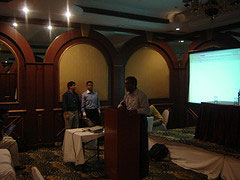
Mr.Thomas shared his inputs on Technical Writing and reminded the gathering of the launching of his India's first Online Newspaper, Deccan Herald. He saw technical writing a boon for the next generation and said that it should be a part of the curriculm.
Next was the launch of http://twin-india.org that is developed using the content management tool -Drupal. Pradeep Vasudevan gave a brief on how the work on the revamping of portal was started and handed it over to Suman Kumar. Suman presented an overview of how the revamping of portal was done and why they chose to use Drupal instead of other CMS tools like Mambo etc.
A few of the objects while selecting the CMS tool were :
Open-source
Price
User-friendly
Capability of handling features
Search Capabilty
After Suman had completed the presentation few questions were asked as if it would be possible to attach a file these days while sending posts in TWIN. Gururaj responded that by saying that it would depend on the 'theme of the file' and the moderator needs to approve the file first to be posted. A break was taken after that!
After relishing the delicacies of Jamoon, sandwich and samosas, Francis asked senior technical writers to share their TWIN experience. Miss. Vasudha spoke first and than Akash Dubey in his comical note delivered a speech. I was honored to read out a speech of ex-STC India President Mr.Makrand Pandit. A few points that Makrand etched out in his note were to reduce the flame wars that takes place in TWIN these days and to find out some good technical writers from the forum.

The meeting ended with the TWIN List Admin, Sandeep giving the vote of thanks. We all than dispersed.
It was a very eventful occasion perhaps a few more technical writers would have done great.
So enjoy the new portal, and in case you haven't browse through take a look at it http://twin-india.org.
These are my personal comments and in way are related to any groups. In case you wish to respond, please send me your comments at holypriest@gmail.com
I reached exactly at 4:30 sharp at the venue Nahar Cottage that is on St.Marks Road. Gururaj,who welcomed all the dignitaries and was looking stunning in his dark green shirts. The host for the show was Anthony Francis,a versatile technical writer who after welcoming the audience asked Mr.John Thomas, the Vice Dean at the Indian Institute of Journalism and New Media, to launch the the TWIN portal at Hotel Nahar Heritage, Bangalore.

Mr.Thomas shared his inputs on Technical Writing and reminded the gathering of the launching of his India's first Online Newspaper, Deccan Herald. He saw technical writing a boon for the next generation and said that it should be a part of the curriculm.
Next was the launch of http://twin-india.org that is developed using the content management tool -Drupal. Pradeep Vasudevan gave a brief on how the work on the revamping of portal was started and handed it over to Suman Kumar. Suman presented an overview of how the revamping of portal was done and why they chose to use Drupal instead of other CMS tools like Mambo etc.
A few of the objects while selecting the CMS tool were :
Open-source
Price
User-friendly
Capability of handling features
Search Capabilty
After Suman had completed the presentation few questions were asked as if it would be possible to attach a file these days while sending posts in TWIN. Gururaj responded that by saying that it would depend on the 'theme of the file' and the moderator needs to approve the file first to be posted. A break was taken after that!
After relishing the delicacies of Jamoon, sandwich and samosas, Francis asked senior technical writers to share their TWIN experience. Miss. Vasudha spoke first and than Akash Dubey in his comical note delivered a speech. I was honored to read out a speech of ex-STC India President Mr.Makrand Pandit. A few points that Makrand etched out in his note were to reduce the flame wars that takes place in TWIN these days and to find out some good technical writers from the forum.

The meeting ended with the TWIN List Admin, Sandeep giving the vote of thanks. We all than dispersed.
It was a very eventful occasion perhaps a few more technical writers would have done great.
So enjoy the new portal, and in case you haven't browse through take a look at it http://twin-india.org.
These are my personal comments and in way are related to any groups. In case you wish to respond, please send me your comments at holypriest@gmail.com
Monday, June 05, 2006
A speech worth reading for IT programmers
Hi All,
Get Back to ur Basics!!!
I really enjoyed reading the speech given by Principal Scientist, Adobe Systems. Also got the list of the books we have to get back to…
Advice to young programmers (This is the summary of speech Given by Alex Stepenov (Principal Scientist, Adobe Systems) at Adobe India on 30 Nov 2004. )
1. Study , Study and Study - Never ever think that you have acquired all or most of the knowledge which exists in the world. Almost everybody in US at age of 14 and everybody in India at age of 24 starts thinking that he has acquired all the wisdom and knowledge that he needs. This should be strictly avoided. - You should be habituated to studies...exactly in the same way as you are habituated to brushing
teeth and taking bath every morning.
The habit of study must become a 'part of your blood'. And the study should be from both the areas: CS,since it is your profession, and something from non-CS...Something which doesnot relate to your work. This would expand your knowledge in other field too. A regular study, everyday, is extremely essential. It doesnot matter whether you study of 20 minutes of 2 hours, but consistency is a must. - You should always study basics and fundamentals.
There is no point in going for advanced topics. When I was at the age of 24, I
wanted to do PhD in program verification, though I was not able to understand anything from that. The basic reason was that my fundamental concepts were not clear. Studying 'Algebraic Geometry' is useless if you donot understand basics in Algebra and Geometry. Also, you should always go back and re-read and re-iterate over the fundamental concepts. What is the exact definition of 'fundamental'? The stuff which is around for a while and which forms basic part of the concepts can be regarded as
more fundamental. Of course, everybody understands what a fundamental means. - Here are few books which I would strongly recommend that every CS professional should read and understand.
i."Structure and Interpretation of Computer Programs" by Albenson and Sussman I
personally donot like the material present in this book and I do have some objections about it but this is the best book I have ever seen which explains all the concepts in programming in a clear and excellent way.
ii.Introduction to Computer Architecture: by Hennessy and Patterson.
How many of you have shipped the programs by writing them in assembly? A very good understanding of basics of how a computer operates is what every CS professional must have. H&P Wrote two books on CA. I am talking about their first book, the introductory text for understanding basic aspects of how a computer works. Even if you feel that you know whatever is written in that book, donot stop reading. It's good to revise basics again and again.
iii."Fundamentals of Programming" by Donald Knuth. The core of CS is algorithms and Data structures. Every CS professional must have the 3 volumes of Knuth's Book on programming. It really does not matter if you take 30 years of your life to understand what Knuth has written, what is more important is that you read atleast some part of that book everyday without fail.
iv. Introduction to Algorithms by Cormen, Leiserson and Rivest This book should be read daily to keep your concepts fresh. This is the best book for fundamental concepts in algorithms.
2. Learn Professional Ethics - As a CS Professional, you are morally obliged to do a good job. What this means is that you are supposed to do your job not for your manager but for yourself. This is already told in Bhagwatgeeta : Doing duties of your life. - The direct implication of this is: never ever write a bad code. You don't need to be fastest and run after shipping dates; rather you need to write quality code. Never write junk code. Rewrite it till it is good. Thoroughly test every piece of code that you write. Donot write codes which are "sort of allright". You might not achieve perfection, but atleast your code should be of good quality. - Let me quote my own example in this context.
You might have heard about STL, The Standard Template Library that ships in with C++ compilers. I wrote it 10 years ago, in 1994. While implementing one of the routines in the STL, namely the "search routine", I was a bit lazy and instead of writing a good linear order implementation of KMP which was difficult to code, I wrote a best quadratic implementation. I knew that I could make the search faster by writing a linear-order implementation, but I was lazy and I did not do that. And, after 10 years of my writing STL, exactly the same implementation is still used inside STL and STL ships with an inefficient quadratic implementation of search routine
even today!! You might ask me: why can't you rewrite that?
Well...I cannot, because that code is no more my property!! Further, nobody today
will be interested in a standalone efficient STL ...people would prefer one which automatically ships out with the compiler itself. - Moral is, you should have aesthetic beauty built inside you. You should "feel" uneasy on writing bad code and should be eager to rewrite the code till it becomes upto the quality. And to the judge the quality, you need to develop sense regarding which algorithms to use under what circumstances.
3. Figure out your Goals - Always aspire doing bigger things in life - "Viewing promotion path as your career" is a completely wrong goal. If you are really interested in studying and learning new things, never ever aspire for being a manager. Managers cannot learn and study...they have no time. "Company ladder aspiration" is not what should be important for you. - You might feel that you want to do certain things which you cannot do till you become a manager.
When you become a manager, you will soon realize that now you just cannot do anything! - You will have a great experience as programmers. But if you care for people and love people, you will never enjoy being a manager...most good managers are reluctant managers. If you see people as people, you cannot survive at management level. - Always aspire for professional greatness. Our profession is very beautiful because we create abstract models and implement them in reality.
There is a big fun in doing that. We have a profession which allows us to do creative
things and even gives nice salary for that. - The three biggest mistakes that people usually make are aiming for money, aiming for promotion and aiming for fame. The moment you get some of these, you aspire for some more...and then there is no end. I donot mean that you shouldnot earn money, but you should understand how much money would satisfy your needs. Bill Clinton might be the richest person in the world; he is certainly not the happiest. Our lives are far better than his. - Find your goal, and do best in the job that you have. Understand that what is in your pocket doesnot matter...what is in your brain finally matters. Money and fame donot matter. Knowledge matters.
4. Follow your culture I have seen the tradition that whatever junk is created in US, it rapidly spreads up in the rest of the world, and India is not an exception for this. This cultural change creates a very strong impact on everybody's life. Habits of watching spicy Bollywood or Hollywood movies and listening to pop songs and all such stupid stuff gets very easily cultivated in people of your age...but believe me,
there is nothing great in that. This all just makes you run away from your culture. And there is no wisdom in running away from your culture.
Indian culture, which has great Vedas and stories like Mahabharata and Bhagwatgeeta is really great and even Donald Knuth enjoys reading that. You should understand that fundamental things in Indian culture teach you a lot and you should never forget them. Finally, I would like to conclude by saying that it's your life...donot waste it on stupid things...develop your tests, and start the fight.
Subscribe to:
Posts (Atom)